
Bobcat publishes its skid steer and compact track loader service schedule in hours, and the families are the same across most of the S-series (wheeled) and T-series (tracked) lineup: grease and fluid checks every 8–10 hours, a first oil and filter change at 50 hours on a new machine, engine oil and filter every 250 hours, hydraulic and fuel filters every 500, and hydraulic fluid and coolant at 1,000. The rest of this guide fills in what those intervals actually involve, which fluids go where, and what breaks on these machines in Tulsa-area dirt.
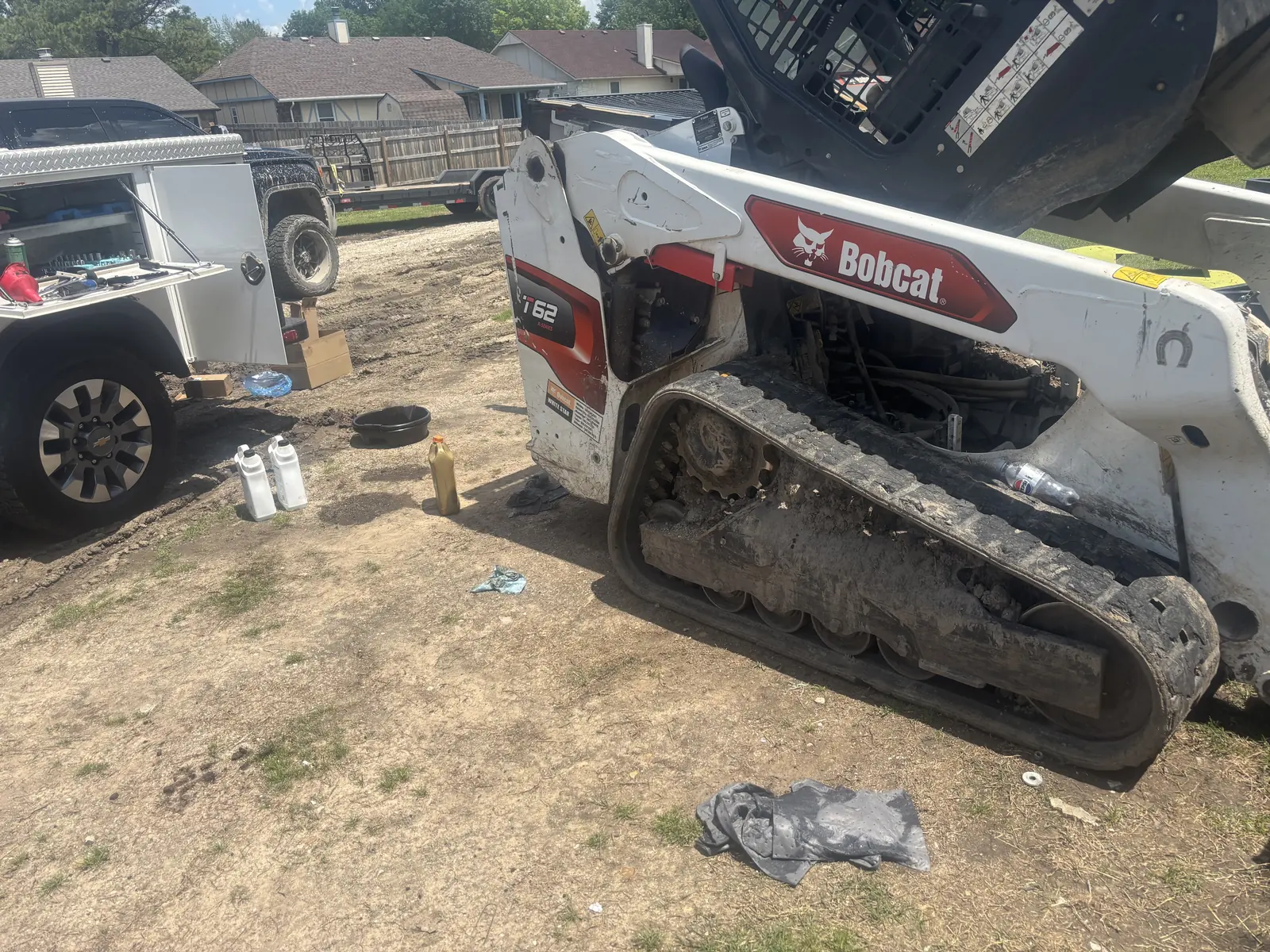
Fluids and Supplies to Have On Hand
- Engine oil: Bobcat 15W-40 or an equivalent API CK-4 (CJ-4 is acceptable on older engines). Machines with a DPF need the low-ash CK-4 spec, not an older CI-4 oil. In a Tulsa winter with sub-20°F mornings, the manual allows a 10W-30 CK-4 for easier cranking; switch back to 15W-40 for summer.
- Hydraulic/hydrostatic fluid: Bobcat hydraulic/hydrostatic fluid. The operator's manual lists the acceptable alternative by serial number; pick one and do not mix them, because the hydrostatic drive pumps and the chaincase on wheeled units both run on this same fluid.
- Coolant: Bobcat's extended-life coolant (ELC) premixed. Do not top off an ELC system with a conventional green coolant; the two chemistries drop out additives together and the mix plugs the radiator.
- Grease: An NLGI #2 EP lithium-based grease. Bobcat Supreme HD or equivalent.
- Filters: engine oil, fuel, fuel/water separator, hydraulic/hydrostatic, engine air (outer and inner), cab air, and the reservoir breather.
Daily / Every 8–10 Hours
- Check engine oil on the dipstick and hydraulic fluid in the sight glass on the reservoir, with the lift arms down and the machine level.
- Check coolant in the recovery bottle, cold.
- Drain the fuel/water separator. Look at the air cleaner restriction indicator; replace the outer element when it trips, not on a calendar.
- Clean the radiator and oil cooler from the engine side out, not just the grille face, and clean the screens. In July and August this one item decides whether the hydraulic fluid stays below its temperature warning.
- Grease every fitting: lift arm pivots at the frame, lift cylinder base and rod ends, tilt cylinder pins, and the Bob-Tach wedges and handle pivots. A Bob-Tach wedge that will not drop fully into the attachment lug is the most common cause of a bucket coming off, so work the handles and confirm both wedges seat.
- Walk the undercarriage or tires. Pull wire and fence from between the track and the rollers; check tire pressure.
- Test the seat bar and the BICS interlocks: the lift and tilt should not move with the seat bar up, and the traction lock should hold.
50 Hours
On a new machine (or a new engine) the 50-hour service is the first engine oil and filter change and the first hydraulic/hydrostatic filter change, to get the break-in metal and assembly debris out. After that, 50 hours is a light check: battery terminals and hold-down, alternator and fan belt condition and tension, chaincase oil level on wheeled units, track tension on T-series, and a look at every hydraulic hose where it runs along the lift arm and through the tower.
250 Hours
- Engine oil and filter. Run the engine to warm the oil before draining, and fill to the dipstick mark, not the capacity number in the manual.
- Check the chaincase oil level on S-series machines. The check plug is on the side of the chaincase; the fluid is the same Bobcat hydraulic/hydrostatic fluid. Low chaincase oil shows up as chain noise at the axles and, later, as worn sprockets.
- Check the drive motor oil level on T-series machines that have a separate planetary oil sump in the final drive.
- Inspect the engine air filter elements, clean the cab air filters, and check the alternator and starter connections for corrosion.
500 Hours
- Replace the hydraulic/hydrostatic filter and the reservoir breather. A plugged breather pulls a vacuum on the tank and starves the charge pump; it is a cheap part that gets skipped.
- Replace the fuel filter and the fuel/water separator element, then bleed the system. Most current Bobcats self-prime with the key on for a minute; older ones have a primer bulb or a bleed screw on the filter head.
- Check the belt tensioner, coolant condition with a refractometer, and tighten the wheel nuts or check track roller bolts.
1,000 Hours (or Every 2 Years)
- Change the hydraulic/hydrostatic fluid and the filter again. Drain the reservoir, clean the suction screen if the model has one, and refill with the same fluid family that was in it.
- Change the chaincase oil on wheeled units.
- Drain and refill the cooling system with Bobcat ELC and pressure-test the system for weeping hoses and a tired cap.
- Change the drive motor planetary oil on T-series machines.
- Inspect the loader frame and lift arm welds, cylinder rods for pitting, and the tower and lift arm bushings for play.
Track Tension and Undercarriage on T-Series Machines
Check tension with the machine raised on the lift arms and bucket so the tracks hang free. Measure the gap between the inside of the track and the bottom of the middle roller; Bobcat lists the spec by model in the operator's manual, and it lands in the range of roughly 3/4 to 1-1/2 inches on most machines. Tighten by pumping grease into the adjuster fitting behind the cover on the track frame; loosen by cracking the bleed fitting slowly and standing clear, because the grease is under real pressure. A loose track walks off the idler on a side slope; an over-tight one loads the idler and drive motor bearings and tears the track's internal cords.
Wear items are the rubber track itself (cracks at the lug base, exposed cords, missing lugs), the sprocket teeth (hooked or pointed), the rollers (flat spots and leaking oil), and the front and rear idlers. Red clay is the problem here. It packs between the rollers and the track, dries hard, and effectively tightens the track while grinding the roller flanges. Knock it out at the end of every day the machine works wet ground, and hose it out before it sets up.
What Fails on These Machines
- Drive motor seals. Oil on the inside of the sprocket on a T-series is the face seal in the final drive letting go. Run it that way and the planetary runs dry.
- Hydraulic hose chafe at the loader arm. The auxiliary and tilt hoses that run up the lift arm rub on the arm and the clamps. A blown hose at full lift dumps the arm; look for shiny spots and bulges at every 50-hour check.
- Chaincase leaks. Axle seals on wheeled machines let chaincase oil out around the hub. Low oil takes the chains and sprockets with it.
- Overheating. Almost always a packed cooler or a blocked screen, not a bad pump. The hydraulic temperature warning on a 100°F afternoon is the machine telling you the cooler needs cleaning.
- ACS and keyless panel faults. Worn keypad membranes, water in the panel, and joystick or control calibration faults show up on the display as codes. Most are wiring, connector, or calibration problems, not a bad controller.
FAQ
Can the full 500- or 1,000-hour service be done at the jobsite?
Yes. Fluids, filters, chaincase, coolant, track tension, and undercarriage inspection are all service-truck work; see preventive maintenance and Bobcat repair.
Do I need Bobcat-branded fluids?
The engine oil and coolant have equivalents that meet the same specs. The hydraulic/hydrostatic fluid is where the manual's list matters; whichever approved fluid the machine has, stay with it.
Need This Done On-Site in Tulsa?
Tulsa Fleet Repair is a mobile operation — the service truck comes to your yard, jobsite, or breakdown location anywhere within 120 miles of Tulsa, with 24/7 emergency response when a unit can't wait. Call (918) 925-9356 or request service online.