
A truck AC system almost never dies without warning. It cools intermittently, or blows warm at a stoplight and cold on the highway, or the compressor clutch starts clicking on and off every few seconds. Each of those symptoms points to a different cause, and most of them are cheap to fix in April and expensive to fix in July when the cab is 130°F and the driver is refusing the truck. This guide covers what each warning sign means, what the gauges should read in Oklahoma heat, and what to check before summer.
Symptom-by-Symptom: What the AC Is Telling You
Cools sometimes, not others
Intermittent cooling is usually a low charge. As refrigerant leaks out, the low-side pressure drops far enough on hot days that the low-pressure cycling switch shuts the compressor off to protect it, then lets it run again once pressure recovers. The driver gets cold air for a minute, warm air for a minute. A failing cycling switch, a loose clutch connector, or a relay that drops out when hot will do the same thing, so confirm the charge with gauges before replacing parts.
Hot at idle, cold at highway speed
This one is airflow across the condenser, not refrigerant. At speed, ram air carries heat away from the condenser; at idle, the fan has to do it alone. If the fan clutch is weak, an electric fan is not coming on, or the condenser fins are packed with debris, high-side pressure climbs at idle, the system loses capacity, and the vents go warm sitting in traffic on the Broken Arrow Expressway. A viscous fan clutch that spins freely with no resistance when the engine is off and hot is done. On Class 8 trucks with an air-engaged fan clutch, the AC high-pressure switch should command the fan on; if it does not, check the switch and the solenoid before condemning the compressor.
Compressor cycling fast
A healthy system on a hot day runs the compressor almost continuously. If the clutch is clicking on and off every few seconds, the low side is hitting the cut-out pressure over and over, which nearly always means low charge. It can also come from restricted airflow through the evaporator (a plugged cab filter or an evaporator packed with leaves) letting the coil get cold enough to trip the switch.
Grinding, rattling, or squealing with the AC on
A noise that appears only when the clutch engages comes from the compressor or its clutch. A dry, rumbling grind is the clutch pulley bearing; it will run without the AC on because the pulley always turns, but it gets louder under load. A knock or internal rattle with the clutch engaged is the compressor itself. A squeal on engagement is a slipping clutch (check the air gap, typically 0.015 to 0.030 inch) or a glazed belt. If a compressor has started shedding metal internally, the whole system has to be flushed, and the receiver-drier or accumulator, the expansion valve or orifice tube, and often the condenser get replaced with it. Parallel-flow condensers cannot be flushed clean, which is why a seized compressor becomes a full-system job.
Reading the Gauges on a 100°F Day
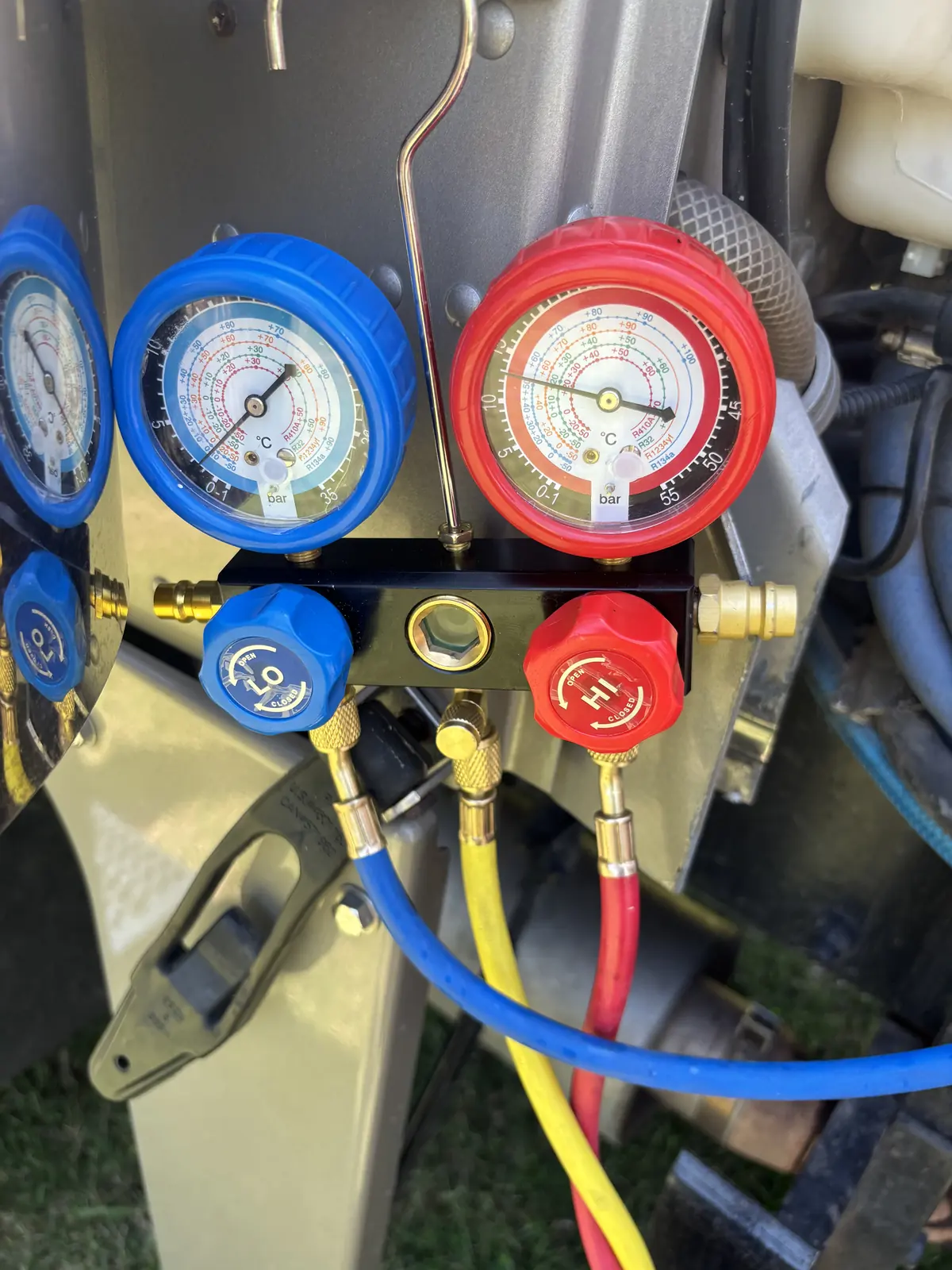
Gauge readings depend heavily on ambient temperature, and Tulsa in July gives you a hard test. These are typical R-134a numbers at the vents on recirculate, engine at about 1,500 rpm, doors closed, with the ambient around 100°F. Treat them as a pattern to recognize rather than a spec sheet; the OEM service manual has the exact table for each truck.
| Low side | High side | What it usually means |
|---|---|---|
| 35–50 psi | 250–330 psi | Normal for R-134a around 100°F ambient. Vent temperature should be roughly 40–50°F, and at least 30°F below cab temperature. |
| Low (under 25 psi) | Low (under 200 psi) | Low charge. Find the leak; do not just top it off. |
| High | High | Overcharge, poor condenser airflow (fan clutch, dirty fins), or air in the system. |
| High | Low | Weak compressor; it is not building pressure differential. |
| Into vacuum or near 0 psi | Normal or low | Restriction: plugged orifice tube, stuck expansion valve, or ice in the system from moisture. |
R-134a vs. R-1234yf
Most light-duty pickups and vans built in roughly the last several model years use R-1234yf; most Class 6–8 trucks and older units still use R-134a. The two use different service fittings on purpose. R-1234yf is mildly flammable, requires its own recovery and charging equipment, and carries a much higher price per pound, so a small leak that would have been a cheap top-off on an R-134a truck is worth chasing properly on a yf truck. Never mix them, and never charge either one with a "stop-leak" product; sealers plug the recovery equipment and the expansion valve along with the leak. Federal law requires refrigerant to be recovered, not vented, on any service that opens the system.
Why Condenser Fins Matter More in Oklahoma
The condenser sits in front of the radiator and the charge-air cooler and sees everything the road throws at it. Around Tulsa that means cottonwood fluff in late May and June, red-clay dust from county roads and jobsites, and grass from mowing crews. A condenser that is even a third blocked cannot reject heat at idle, and high-side pressure climbs until the high-pressure switch shuts the compressor down. Clean it from the engine side outward with low-pressure water or air, straighten folded fins with a fin comb, and pull the grille if the fluff is packed between the condenser and the cooler stack. Do not use a pressure washer up close; it lays the fins flat and makes the blockage permanent.
Belt, Clutch, and Wiring Inspection
- Serpentine belt: cracks, glazing, and a tensioner that bounces at idle. A belt that slips under compressor load on a hot day will cook the clutch.
- Clutch air gap: measure with a feeler gauge between the clutch plate and pulley. Too wide and it will not pull in when hot because the coil's resistance rises with temperature.
- Clutch coil: check for battery voltage at the connector with the AC commanded on; no voltage means a pressure switch, relay, or control head issue rather than a compressor problem.
- Compressor shaft seal: an oily, dust-caked ring around the front of the compressor is a leak.
Pre-Summer AC Checklist
- Run the system for ten minutes on a warm day and record vent temperature and both gauge pressures.
- Verify the fan comes on with the AC (electric) or roars when hot (viscous clutch).
- Clean the condenser and radiator stack; check the charge-air cooler for damage.
- Replace the cab filter (on many medium-duty and Class 8 cabs it is behind the cowl or under the hood on the passenger side) and clear the evaporator drain.
- Inspect belt, tensioner, and clutch air gap.
- Inspect every fitting and the compressor nose for oil residue; dye test if the charge is low.
- Fix the leak, replace the drier if the system was open, pull a deep vacuum, and charge by weight to the label spec. Charging by pressure alone leads to overcharged systems that fail on the hottest days.
FAQ
How cold should truck AC blow?
On a healthy system at highway rpm with recirculate on, 38–45°F at the center vent is typical. On a 100°F day with the truck sitting at idle, 48–55°F is acceptable; anything warmer at speed means something is wrong.
Can the compressor run without refrigerant?
Not for long. The refrigerant carries the compressor oil. The low-pressure switch exists to keep the compressor from running on an empty system; bypassing it or jumpering the clutch to "test" it will finish the compressor off.
Can AC work be done on-site?
Yes. Gauge diagnosis, leak detection, component replacement, evacuation, and charging can all be done from the service truck at your yard. See our diagnostics and preventive maintenance pages for what a spring AC inspection covers on trucks, vans, and equipment cabs.
Need Truck AC Diagnosed On-Site in Tulsa?
Tulsa Fleet Repair is a mobile operation — the service truck comes to your yard, jobsite, or breakdown location anywhere within 120 miles of Tulsa, with 24/7 emergency response when a unit can't wait. Call (918) 925-9356 or request service online.