
Whether to rebuild or replace a hydraulic pump comes down to three things: what kind of pump it is, what the tests say about it, and whether the thing that killed it has been fixed. Gear pumps usually get replaced, vane pumps get a new cartridge, and axial piston pumps are the ones worth rebuilding when the housing and barrel are sound. None of that matters if the replacement goes back into a system full of the last pump's metal, or into a machine that is cavitating because the suction strainer is plugged.
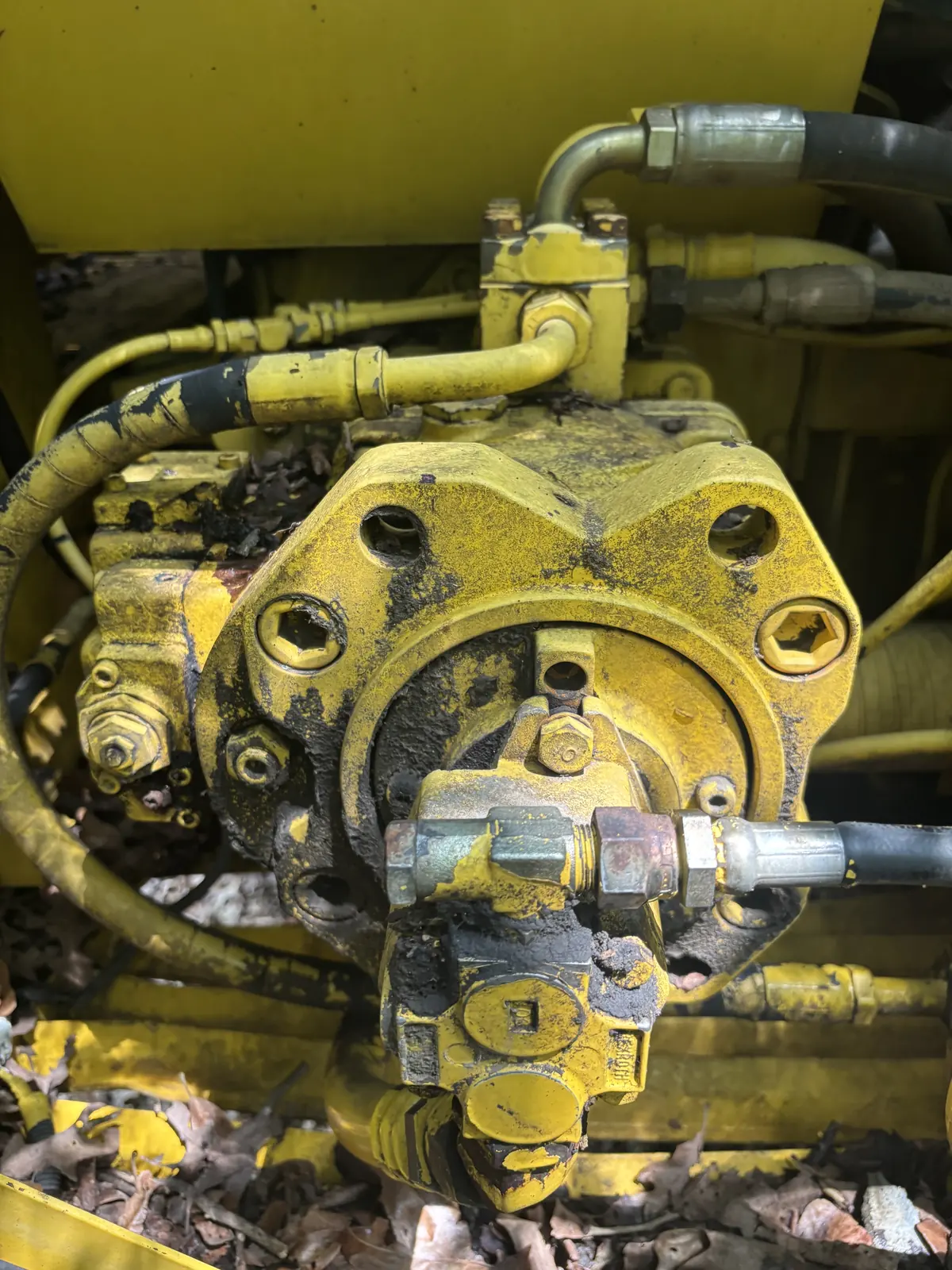
Pump Types and How They Rebuild
External gear pumps
Loader auxiliary circuits, skid steer charge and implement circuits, older backhoes, telehandlers. Two gears in an aluminum or cast housing with wear plates and bushings. As the gears wear the housing bore, flow drops off under pressure. A reseal kit fixes a shaft-seal leak on a low-hour pump, but once the housing is scored the pump is done, and a new gear pump costs little next to the labor to open one. Replace.
Vane pumps
Forklifts, industrial equipment, and truck-mounted wet kits (the Vickers V and VQ series are typical). The rotor, vanes, ring, and port plates come as a cartridge that drops into a reusable housing. The most rebuildable pump there is.
Axial piston pumps
Excavator main pumps (Kawasaki K3V and K5V on Komatsu, CAT, Case, Deere, and Kobelco machines), the variable-displacement pumps on skid steers and track loaders (Rexroth A10VO), and hydrostatic drive pumps (Rexroth A4VG, Danfoss Series 90). These are the expensive ones and the ones worth rebuilding. Wear parts are the pistons and shoes, cylinder barrel and valve plate, swashplate, bearings, and seals. If the barrel and valve plate can be lapped or replaced and the housing is not cracked, a rebuild performs like new. A bent shaft, a cracked housing, or a barrel bore past saving means a reman exchange unit.
Prove It Is the Pump First
Slow, weak, noisy, and hot are the complaints, and each is shared with a stuck or low-set relief, a bypassing cylinder, a worn motor, a restricted suction line, or the wrong oil.
- Flow at rated RPM. An in-line flow meter with a loading valve on the pump outlet. Read flow at low pressure, then load it to rated pressure. A healthy pump loses only a little flow as pressure rises; a worn pump falls off sharply as oil slips past the wear surfaces.
- Case drain flow on piston pumps. Case drain is internal leakage returning to tank, and it is the best single wear indicator on a piston pump. Time it into a bucket or meter it. A small, steady share of output is normal; a case drain that has grown to a large share, or a case drain hose noticeably hotter than the outlet, means the pump is worn.
- Pressure. A gauge at the outlet with the circuit dead-headed against the main relief. If pressure will not reach spec, adjust or replace the relief before condemning the pump. If pressure is right but functions are slow, it is a flow problem: pump or a leaking actuator.
- Suction vacuum. A vacuum gauge on the inlet. Most piston pumps want no more than roughly 5 inHg at operating temperature. More means a plugged strainer, a collapsed hose, or a breather so clogged the tank cannot breathe.
- Temperature. Oil above about 180°F oxidizes, varnishes, and hardens seals. Point an infrared thermometer at the pump, the relief valve, each cylinder, and the cooler. A hot relief is dumping. A hot rod end is a bypassing cylinder. A hot pump with a clean cooler and a quiet relief is making heat through internal leakage.
- Oil sample and filter. Draw a mid-stream sample from a live port and send it out. The lab returns an ISO 4406 cleanliness code (three numbers such as 18/16/13, counting particles larger than 4, 6, and 14 microns), plus water, viscosity, and wear metals: copper points at bushings and wear plates, iron at gears and barrels, chrome at cylinder rods. Piston pumps want roughly 18/16/13 or cleaner; gear systems tolerate 19/17/14. Cut the filter open and check the magnetic plug.
Root Causes That Will Kill the New Pump Too
- Cavitation. A suction restriction (plugged strainer, blocked breather, collapsed hose, oil too thick on a cold morning, throttle jammed to high idle at startup) drops inlet pressure until the oil vaporizes, and the bubbles collapse against the valve plate or gear housing like a hammer. It sounds like gravel in the pump. Fix the inlet or the next pump goes the same way.
- Aeration. Air pulled in through a loose suction fitting or a bad shaft seal, whipped in by a return line discharging above the oil level, or from running low. Milky oil, spongy functions, a rattle that changes with oil level.
- Wrong viscosity for the season. With 100°F ambient and a loaded cooler, Oklahoma summers put the oil at 180°F and beyond. ISO 32 that was fine in March goes thin, internal leakage climbs, heat climbs, and the oil thins further. Most equipment calls for ISO 46 or a multigrade hydraulic oil (CAT Hydo Advanced, Deere Hy-Gard, Bobcat hydraulic/hydrostatic fluid); check the chart against ambient. Too thick in January cavitates the pump at startup instead.
- A packed cooler. Cottonwood fluff in May and June, red dust all summer, chaff on ag equipment. Blow it out from the back side, not just the face.
- Contamination from a failed component. A scored cylinder, a worn motor, or the last pump failure sent metal through the system, and the return filter caught only some of it. The rest is in the tank, valve body, cylinders, cooler, and hoses, waiting for the new pump. Clean the tank, flush lines, replace hoses that cannot be flushed, open any cylinder that failed, fit new filters, and change them again at fifty hours.
- Drive problems. Fretted splines on excavator pump couplings that never saw grease, worn skid steer drive couplings, an over-tightened belt, a bent shaft. A pump that failed at the shaft usually had help.
Decision Table
| Situation | Rebuild | Replace |
|---|---|---|
| Gear pump, shaft seal weeping, low hours | Reseal | |
| Gear pump, scored housing or low flow under load | New pump | |
| Vane pump, low flow or noisy | New cartridge | |
| Piston pump, housing sound, barrel and valve plate serviceable | Rebuild | |
| Piston pump, cracked housing, bent shaft, or barrel bore gone | Reman exchange | |
| Machine is earning money and a reman is on the shelf | Reman exchange, keep the core | |
| System contaminated, cause unknown | Neither until the cause is found and the system is cleaned | |
A rebuild needs a clean bench, measuring tools, a press, and ideally a test stand before the pump goes back on. In the field, a rebuild means a reseal. Everything else is bench work.
What Mobile Service Covers
Diagnosis is field work: flow and pressure testing, case drain measurement, a temperature survey, and an oil sample all happen at the jobsite with the machine warm, and so do pulling and installing the pump, flushing, and tank cleaning. The pump itself goes to a bench, and a reman exchange is often the faster route on excavator main pumps and hydrostatic drives. After install: fill a piston pump's case with clean oil before the first start, bleed, run at low idle before loading, verify the relief setting, change the filter at fifty hours, and sample the oil at 250 hours.
FAQ
Why did my new pump fail within a week?
Contamination or cavitation almost every time. The new pump ate the old pump's metal, or the suction restriction that killed the old one was never found.
Is a reman pump as good as new?
One from the OEM or a rebuilder that test-stands its units is. A pump that was resealed and painted is not, and the two look identical on the pallet.
Need This Done On-Site in Tulsa?
Tulsa Fleet Repair is a mobile operation for hydraulic diagnosis and pump work on excavators, skid steers and track loaders, forklifts, telehandlers, and construction fleets. The service truck comes to your yard, jobsite, or breakdown location anywhere within 120 miles of Tulsa, with 24/7 emergency response when a unit can't wait. Call (918) 925-9356 or request service online.