
Ford has sold four Powerstroke diesels in the Super Duty, and each fails in its own predictable ways. The 7.3L (1994–2003) is tough but has electrical and high-pressure-oil gremlins. The 6.0L (2003–2007) has a reputation that comes down mostly to one part: the oil cooler. The 6.4L (2008–2010) was the first with a DPF and pays for it in fuel-diluted oil. The 6.7L (2011 and up) is the best of the family but carries a high-pressure fuel pump that punishes bad fuel. For service, see Powerstroke repair in Tulsa.
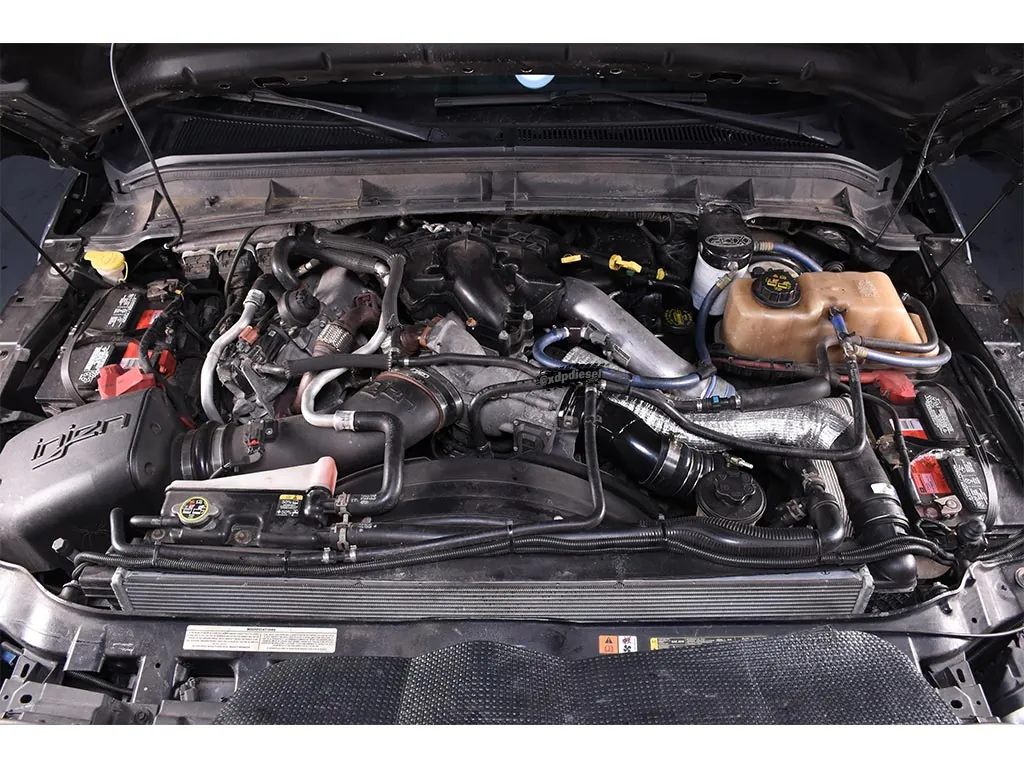
7.3L Powerstroke (1994–2003)
A HEUI engine: the injectors are fired by high-pressure engine oil, so oil level, oil quality, and the high-pressure oil system are where most 7.3 problems live.
- Camshaft position sensor (CPS). The classic 7.3 failure: stalls while driving then restarts, or cranks with no start and no tach signal. Keep a spare in the glove box; it is a five-minute swap on the front cover.
- Under valve cover harness (UVCH). The connectors through the valve cover gasket to the injectors and glow plugs burn and loosen: rough idle, a dead cylinder that comes and goes, glow plug codes. The fix is a new gasket with harness and clean pigtails, not a new injector.
- IPR and ICP. The injection pressure regulator sticks or its screen plugs; the injection control pressure sensor leaks oil into its connector and reports garbage. A 7.3 needs roughly 500 psi of ICP to start; if the scan tool won't show it while cranking, look at the IPR, the high-pressure oil pump, and the oil level first.
- Turbo pedestal and EBPV. The exhaust back-pressure valve and pedestal O-rings leak oil onto the top of the engine. Replace them while the turbo is off and check the up-pipes at the same time.
- Glow plug relay. Hard cold starts with white smoke: test relay output during the glow cycle before buying plugs.
Maintenance: 15W-40 CK-4 every 5,000 miles, no exceptions, because the oil is a hydraulic fluid on this engine. Fuel filter every 10,000 to 15,000. Coolant with proper SCA or a fully formulated ELC, because 7.3 liners cavitate.
6.0L Powerstroke (2003–2007)
Also HEUI, with a variable-geometry turbo, an EGR cooler, and the part that started most of its trouble: a stacked-plate engine oil cooler that plugs with casting sand and coolant debris.
- Oil cooler. When it plugs, coolant flow drops, the EGR cooler downstream starves and cracks, and the engine runs hot oil. The test is simple: at operating temperature on the scan tool, engine oil temperature should be within about 15°F of coolant temperature. A wider gap means a restricted cooler; replace it with a coolant flush.
- EGR cooler. Cracks and pushes coolant into the intake and exhaust: sweet white smoke, a degas bottle that overflows, unexplained coolant loss. Pressure-test it; replace it with an upgraded unit and fix the oil cooler at the same time or it fails again.
- Head gaskets and TTY bolts. The factory torque-to-yield head bolts let go under high cylinder pressure: pressurized cooling system, coolant loss with no leak, a degas bottle that fizzes at idle. The correct repair is head gaskets with ARP studs, heads checked for flatness, and new injector O-rings.
- FICM. The fuel injection control module must put out about 48 volts. Below 45, especially cold, you get rough cold starts, misfires, and no-starts. Measure it at the module KOEO, cranking, and running; repair or replace the power supply board.
- STC fitting and stand pipes. On 2004.5-and-later engines the snap-to-connect fitting on the high-pressure oil branch tube leaks and causes a hot no-start. Update the fitting, stand pipes, and dummy plugs together.
"Bulletproofing" is a marketing term, not a Ford procedure. It usually means replacing the oil cooler, EGR cooler, head studs, and FICM in one job. That list is reasonable on an engine that already needs heads pulled; on one that doesn't, the honest version is a good oil cooler, a coolant filter, clean fuel filters, and checking the oil-versus-coolant delta at every PM visit.
6.4L Powerstroke (2008–2010)
Common rail with piezo injectors, sequential twin turbos, and the first Powerstroke DPF. The aftertreatment strategy is what creates most 6.4 problems.
- Fuel in the oil. Active regens use late post-injection to heat the DPF, and some of that fuel washes past the rings. A rising dipstick is fuel. Change oil at 5,000 miles or sooner if the level climbs, and don't let a 6.4 live in constant regen from short trips.
- DPF and regens. Trucks that never see highway temperature soot up. A P2463 (soot accumulation) or repeated "cleaning exhaust filter" messages call for a parked regen and a look at what is blocking passive regen: a stuck EGR, a leaking up-pipe joint or EGR cooler, or a bad EGT sensor.
- Radiator. The plastic end tanks crack at the crimp; watch for coolant on the front of the engine and a low degas bottle.
- Twin turbos. Oil coking in the small high-pressure turbo and worn bearings from stretched oil intervals. Blue smoke on decel or a whine that changes with boost points there.
- Injectors and K16 high-pressure pump. Both punish bad fuel. Rail pressure that can't hold commanded (P0087) usually means a leaking injector or a tired pump; measure injector return volume before buying a pump.
6.7L Powerstroke (2011 and up)
The Ford-designed "Scorpion." It fixed the previous generation's worst habits and introduced one serious one.
- CP4.2 high-pressure fuel pump. When a roller lifter in the Bosch CP4 rotates or the pump runs dry, it sheds metal through the rail, injectors, and return lines: sudden stall or no-start with P0087 and metal in the fuel filter. A proper repair replaces the pump, all injectors, rail, and lines and flushes the tank; a pump-only fix comes back. Prevention is fuel discipline: both fuel filters (frame-mounted HFCM and engine-mounted secondary) every 10,000 to 15,000 miles, drain the HFCM water separator every oil change, buy from high-volume stations, and nothing above B20.
- Turbocharger. The 2011–2014 Garrett GT32 with ceramic ball bearings had bearing failures; 2015-and-later trucks got a different turbo. Oil quality and a cool-down before shutdown matter.
- EGT sensors. Four on the early trucks; one out of range disables regen and sets codes in the P0544 and P242A/P242B/P2033 families. Replace with the OEM part and clear adaptive values.
- Glow plugs. Early 6.7 glow plug tips could break off; hard cold starts and a misfire after a cold start are the tell.
- DEF and SCR. The truck monitors DEF quality and derates to 5 mph on "exhaust fluid quality poor" if the DEF is contaminated, diluted, or old. Use ISO 22241 DEF from a sealed container, keep the cap area clean, and expect DEF heater and NOx sensor faults (P20B9, P2200/P229F families) to need real diagnosis rather than parts-swapping.
Maintenance: CK-4 10W-30 or 5W-40 per the door-jamb chart, 5,000 to 7,500 miles on a work truck; both fuel filters at every second oil change at the latest; DEF from a sealed jug; coolant tested yearly; the 2011–2016 primary radiator watched for a pink crust at the tanks.
Generation Quick Reference
| Engine | Years | Injection | First thing to check |
|---|---|---|---|
| 7.3L | 1994–2003 | HEUI | ICP pressure while cranking, CPS, UVCH connectors |
| 6.0L | 2003–2007 | HEUI | Oil vs. coolant temperature delta, FICM voltage, degas bottle |
| 6.4L | 2008–2010 | Common rail, piezo | Oil level rising, soot load, radiator end tanks |
| 6.7L | 2011+ | Common rail, CP4.2 | Fuel filter for metal, rail pressure vs. commanded, DEF quality |
Tulsa Notes
Summer heat over 100°F is hard on the 6.0's marginal cooling: an oil cooler halfway plugged in April is fully plugged by August. Winter cold snaps expose weak FICMs, tired glow plugs, and gelled fuel. Farm and ranch trucks around Bixby, Claremore, and Muskogee that fill from a transfer tank are the ones that show up with CP4 metal, because water and sediment in a jobsite tank find the pump first.
FAQ
Which Powerstroke is the most reliable?
The 7.3L for simplicity and the 6.7L for everything else, provided the 6.7 gets clean fuel. A 6.0L with a good oil cooler and head studs is a solid engine; a neglected one is not.
Is my 6.0L going to blow a head gasket?
Not if the oil cooler flows, the coolant is clean, and it isn't pushed past what the head bolts can hold. The oil-versus-coolant delta and the degas bottle tell you months ahead.
Can Powerstroke work be done at my yard?
Most of it: oil coolers, EGR coolers, FICM, turbo, injectors, fuel system, radiators, and all diagnostics. A 6.0 head gasket job is cab-off work and goes to the shop.
Need Powerstroke Repair On-Site in Tulsa?
Tulsa Fleet Repair is a mobile operation — the service truck comes to your yard, jobsite, or breakdown location anywhere within 120 miles of Tulsa, with 24/7 emergency response when a unit can't wait. Call (918) 925-9356 or request service online.