A Class 8 truck stays on the road when four things get done on schedule: engine oil and filters, the air brake system, the wheel ends, and the aftertreatment. Most tow-ins trace back to one of those being skipped or stretched. This guide covers the intervals that matter, the failures that show up most in northeast Oklahoma, what a mobile mechanic can fix on the shoulder or in your yard, and what to ask before you hand someone your fleet.
Preventive Maintenance Intervals by System
Use the OEM interval for your engine and duty cycle as the ceiling, not the target. A truck running short-haul inside the Tulsa loop, idling at the Port of Catoosa, or working gravel and red-clay lease roads is on a severe-duty schedule even if the odometer says otherwise.
| System | Typical interval | What gets done |
|---|---|---|
| Engine oil and filters | 25,000 mi severe / 50,000+ mi line-haul, per OEM drain chart | API CK-4 (FA-4 only where approved) in the OEM viscosity: 15W-40 or 10W-30 on Cummins X15, 10W-30 low-viscosity on Detroit DD13/DD15. Full-flow and bypass filters every drain. Oil sample if you want to stretch the interval. |
| Fuel filters | Every oil change, or 15,000 to 25,000 mi | Primary (water separator) and secondary. Drain water every PM, daily in wet weather. Prime properly; an air-locked X15 or MX will crank forever. |
| Coolant | Test every PM; extender at ~300,000 mi / 3 yr on ELC | Extended-life OAT coolant runs to roughly 600,000 mi with one extender dose. Conventional coolant needs SCA test strips every PM; low nitrite means liner cavitation. Never mix chemistries. |
| Air dryer | Cartridge every 12 months or ~100,000 mi | Drain tanks daily. A dryer that stops purging (stuck purge valve, failed heater in winter) sends water through the whole system. |
| Slack adjusters and S-cams | Grease every PM; stroke check every PM and pre-trip | Automatic slacks are greased, not adjusted. One out of adjustment has a cause (worn clevis pin, seized cam bushing, wrong chamber); find it instead of cranking it back in. |
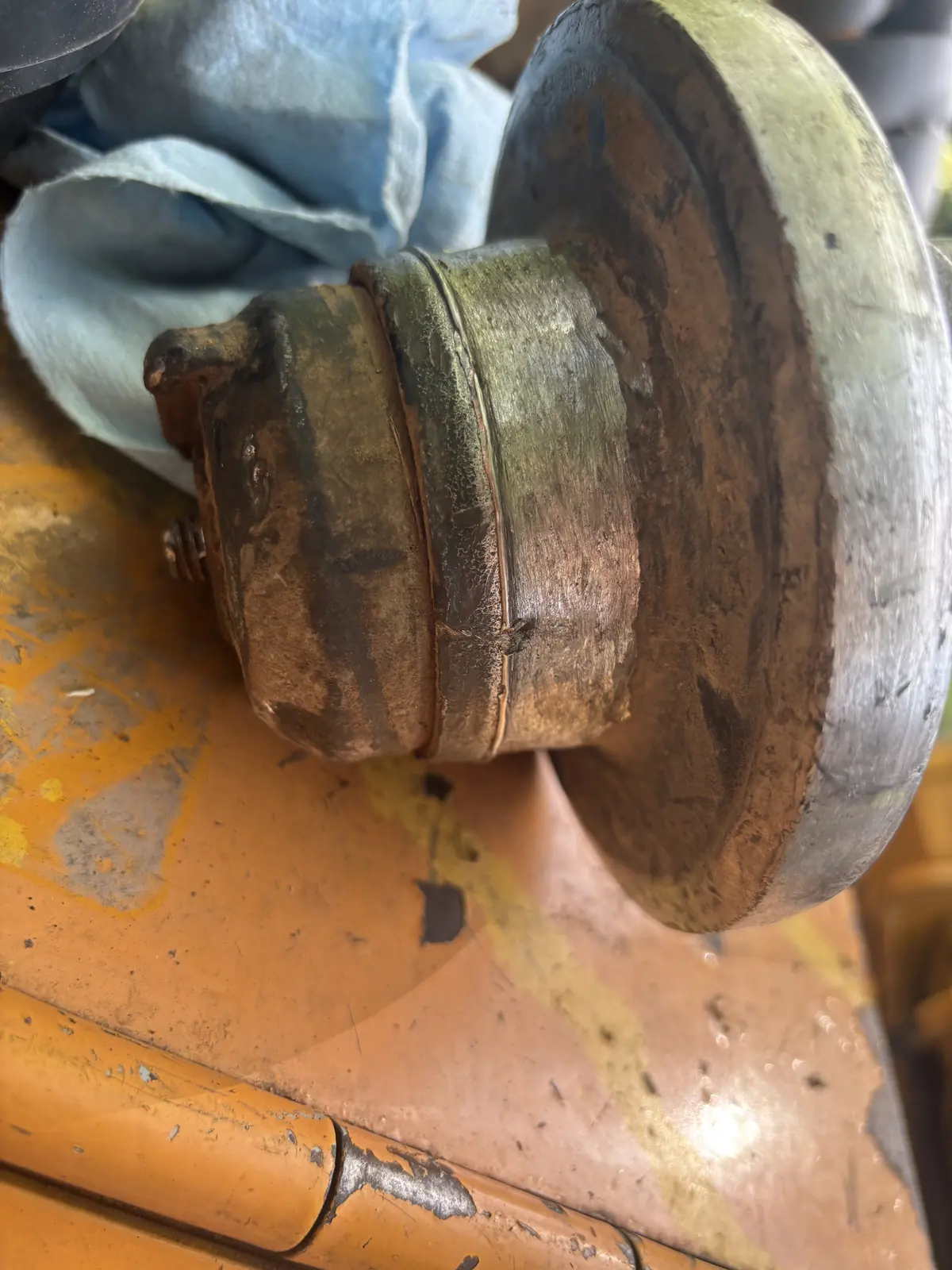
| Wheel ends | Check hub sight glass daily; reseal at brake job or on leak | 75W-90 synthetic in oil-bath hubs. Endplay set with a dial indicator, 0.001 to 0.005 in. Milky sight glass means water; dark and low means a seal is going. |
| DPF ash cleaning | Roughly 200,000 to 400,000 mi | Ash is non-combustible and regens don't remove it. Off-truck cleaning or a swap for a cleaned unit. |
| DEF system | DEF pump filter per OEM; ISO 22241 DEF only | Keep the cap clean, never use a fuel funnel. DEF freezes at 12°F, which matters on a January morning in Bartlesville. |
| Chassis grease | Every PM; every 2 weeks in dust or oil-field work | King pins, tie-rod ends, drag link, spring pins, cam bushings, slack adjusters, fifth wheel, U-joints and slip yoke. |
| Transmission and axles | 250,000 to 500,000 mi synthetic | Eaton and Detroit AMTs have their own approved fluids; don't top an Endurant or DT12 with whatever gear oil is on the shelf. |
The Class 8 Failures That Actually Sideline Trucks
Starting and charging
Four Group 31 batteries under the cab steps, cables that corrode where they can't be seen, and an alternator asked to run an APU, a liftgate, and a sleeper. Weak batteries fail on the first sub-20°F morning; corroded cables show up as a slow crank and a starter that gets blamed. Load test, voltage-drop test every cable and ground, and clean the terminals before anybody buys a starter.
Air brakes and air system
Out-of-adjustment brakes are the most common roadside write-up and the easiest thing to catch on a pre-trip. Pushrod stroke over the limit (2 in. on a standard Type 30 chamber, 2.5 in. on a long-stroke Type 30), a ruptured diaphragm, a cracked drum, a leaking spring brake, or a governor that never cuts out. An air loss over 3 psi per minute with the brakes applied on a combination needs finding, not ignoring.
Cooling
EGR coolers, radiator end tanks, water pump weep holes, and the hoses behind the engine nobody looks at. Tulsa summers run above 100°F for stretches, and a truck that was fine in April pins the gauge climbing out of Sapulpa on the Turner Turnpike in July. Check the fan clutch, the charge-air cooler for leaks, and the radiator for packed bugs and red dust before it becomes a head gasket.
Aftertreatment
NOx sensors, DEF dosers that crystallize, DEF pumps, face-plugged DPFs, and the derates that follow. A truck on stop-and-go routes inside the loop never gets highway heat; its soot load needs watching and a parked regen run before the derate, not after. See the diagnostics page for what a forced regen and aftertreatment test involve.
Wheel seals, lighting, and fuel
A weeping wheel seal becomes an oil-soaked lining, then a smoking hub on US-75. Trailer 7-way corrosion and chafed frame-rail harnesses put marker lights out, and one light out is a violation. Plugged filters from bad fuel, gelled fuel in a cold snap, and suction-side air leaks that cause a hot-restart no-start round out the list. Keep spare fuel filters on the truck in winter.
Mobile Service Versus a Bay
A fully equipped service truck does more on-site than most fleet managers expect, but not everything, and a good mechanic tells you which is which before he drives out.
Done roadside or in your yard
- No-start and no-crank diagnosis, batteries, starters, alternators, cable repair
- Fuel filters, priming, lift pumps, suction-side leak repair
- Belts, tensioners, hoses, thermostats, water pumps, radiator and charge-air cooler replacement
- Air leaks, dryer cartridges and purge valves, brake chambers, slack adjusters, shoes and drums, wheel seals and bearings
- Full PM service and DVIR defect repairs
- OEM-software diagnostics, forced regens, sensor replacement, wiring and connector repair
- Hydraulic hoses, welding on brackets, steps, and fenders
- 49 CFR 396.17 annual inspections at your yard (see the DOT inspection page)
Needs a bay
- In-frame overhauls, head gaskets, cylinder head work
- Transmission and clutch removal on most units
- Off-truck DPF ash cleaning, EGR coolers on some engines
- Alignment, frame work, king pins
For a broader look at what mobile service covers, see semi truck repair in Tulsa and mobile mechanic service.
How to Choose a Semi Truck Mechanic
The right questions separate a parts-changer from a diagnostician in about five minutes.
- What diagnostic software do you carry? The answer should name tools: Cummins INSITE, Detroit DiagnosticLink, PACCAR DAVIE, Volvo/Mack Premium Tech Tool, or a multi-brand tool like JPRO or NEXIQ. A generic code reader won't command a forced regen or run an injector cutout test.
- Do you do 396.17 annual inspections, and does the inspector meet 396.19? Ask how the report and sticker are documented.
- How do you handle a DVIR defect? The repair has to be documented and the DVIR signed off before the truck rolls.
- What is your real response time on I-44 or the turnpike at 2 a.m.? A specific answer beats a slogan.
- What happens when the job needs a bay? Who tows it, where it goes, and who owns the diagnosis in between.
- Will you give me records that satisfy 49 CFR 396.3? Unit ID, date, mileage, what was done, and who did it.
- Are you current on automated manual transmissions and one-box aftertreatment? Not everyone who learned on pre-2007 trucks is.
The mechanic you want is the one who tests before he replaces, writes down what he found, and tells you when the job belongs in a shop instead of on the shoulder.
FAQ
How often should a semi truck get a PM service?
A light PM (grease, fluids, brake stroke, lights, tires) every 10,000 to 15,000 miles and a full PM with oil and filters at the OEM drain interval for the duty cycle. Heavy idling and short-haul belong on the short end.
Can a mobile mechanic do a DOT annual inspection?
Yes. The 396.17 inspection is a visual and functional inspection against Appendix A of Part 396, done in your yard with the truck on level ground and the brakes accessible.
What oil should a Class 8 truck use?
The OEM viscosity, meeting API CK-4. FA-4 only if the engine is approved for it; most 2017+ Detroit and Cummins engines are, most older engines are not.
Need Semi Truck Service On-Site in Tulsa?
Tulsa Fleet Repair is a mobile operation — the service truck comes to your yard, jobsite, or breakdown location anywhere within 120 miles of Tulsa, with 24/7 emergency response when a unit can't wait. Call (918) 925-9356 or request service online.