There is no mileage at which truck brakes need replacing. There is a lining thickness, a drum diameter, a rotor thickness, and a pushrod stroke, and when any of those reaches its limit the component is done, whether that takes 20,000 miles on a refuse truck or 150,000 on a highway tractor. This guide lays out the limits by brake type and weight class, how to measure them, and how the numbers line up with what a roadside inspector is checking.
Light and Medium Duty: Hydraulic Brakes (Class 2–6)
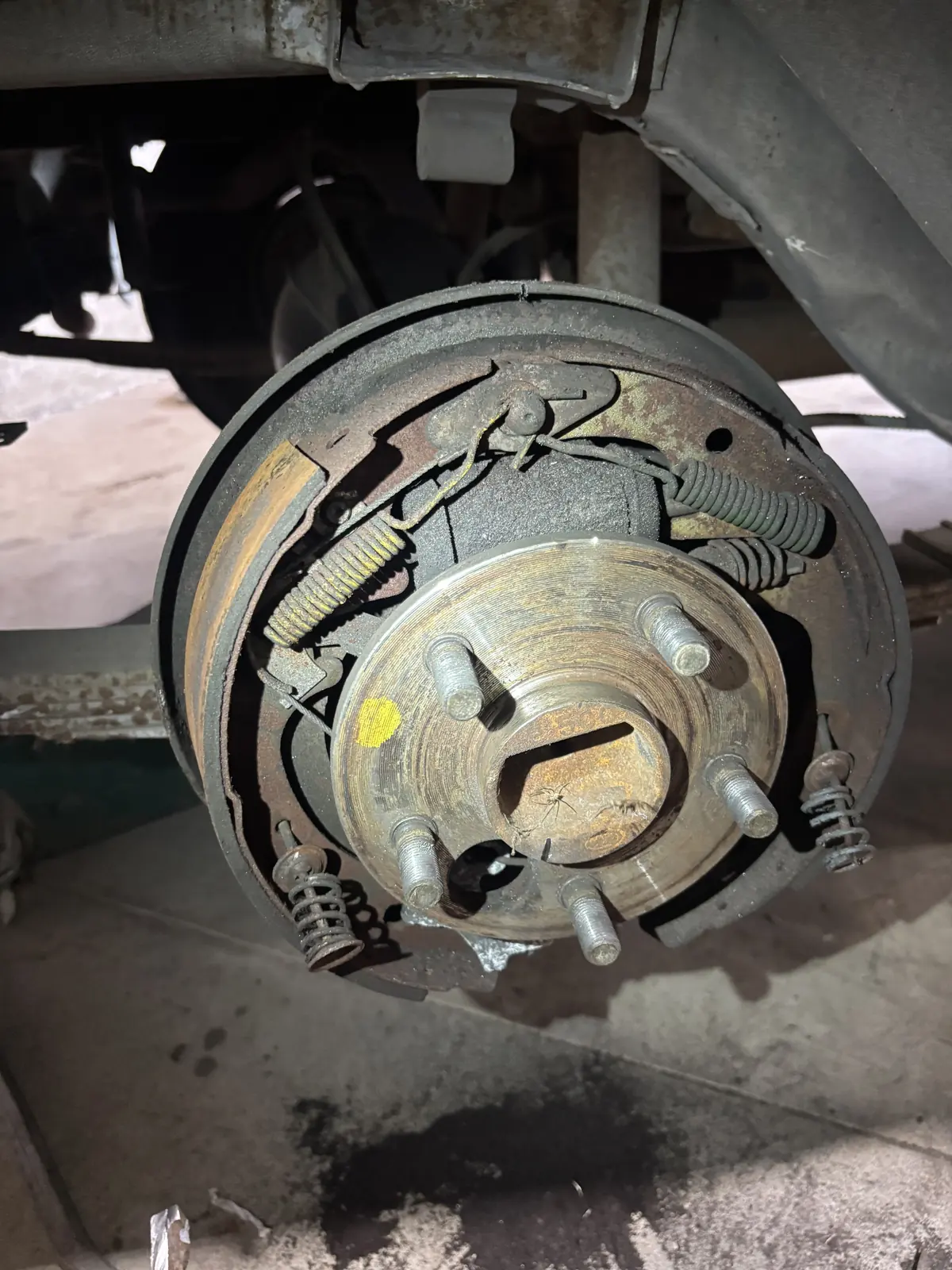
Pickups, Sprinters and Transits, and most Class 3–6 trucks up through the F-650/750, Isuzu NPR/NRR, and Hino conventionals use hydraulic disc or drum brakes, on the larger units with a hydraulic booster instead of vacuum.
- Pads: The regulatory minimum for hydraulic disc and drum linings is 1/16 inch (49 CFR 393.47). That is a limit, not a target. Plan replacement when pads are down to about 3 mm (1/8 inch) so they do not reach the backing plate between service intervals; on a delivery van running stop-and-go inside the loop that can come as soon as 20,000 miles, while a highway-miles pickup may go three times that.
- Rotors: The minimum thickness is cast or stamped on the rotor hat or edge. Measure with a micrometer in several places; replace at or below the minimum, or if runout, deep scoring, or heat cracks are present. Most fleet rotors are replaced rather than turned because the material left after machining is too little to survive another set of pads.
- Drums (rear, light duty): The maximum diameter is stamped on the drum; most are discard at 0.060 inch over nominal.
- Fluid: DOT 3 or DOT 4 per the cap. Brake fluid absorbs water, and at around 3 percent moisture (a test strip will show it) the boiling point drops enough to cause a spongy pedal on a long grade with a load. Flush every two years, or annually on trucks that see heavy towing.
Heavy Duty: Air Brakes (Class 7–8)
Air-braked trucks and trailers use S-cam drum brakes on most axles, with air disc brakes increasingly common on steer axles and some tractors. The limits are set by the CVSA North American Standard Out-of-Service Criteria and FMCSA regulations, and inspectors apply them at the roadside.
Lining thickness
The commonly referenced out-of-service number for air drum brakes is 1/4 inch of lining at the shoe center; the regulatory minimum in 49 CFR 393.47 is 3/16 inch for a shoe with a continuous strip of lining and 1/4 inch for a shoe with two pads, or worn to the wear indicator if the lining has one. Air disc brake pads are out of service below 1/8 inch. In practice, schedule the reline when drum linings reach about 3/8 inch so the truck never gets near either limit, and inspect the lining edge for cracks longer than the width of the lining, chunks missing, and oil or grease contamination from a leaking hub seal, all of which fail a brake regardless of thickness.
Drums and rotors
The discard diameter is stamped on the drum; the common rule for a 16.5-inch drum is 0.120 inch over nominal. Replace any drum with cracks that extend through to the outside, heat checking that covers the friction surface, blue heat spots, or scoring deep enough to catch a fingernail. Air disc rotors carry a stamped minimum thickness the same way hydraulic rotors do, and heat cracks reaching the edge or the hub condemn them at any thickness.
Pushrod stroke: the number that fails the most inspections
Brake adjustment is checked by measuring how far the chamber pushrod travels on a full application. The limit depends on the chamber type and size; the chamber size is stamped on the housing, and long-stroke chambers are usually marked with a square air port or a tag.
| Chamber type | Standard stroke limit | Long-stroke limit |
|---|---|---|
| Type 16 | 1-3/4 in | 2 in |
| Type 20 | 1-3/4 in | 2 in |
| Type 24 | 1-3/4 in | 2 in (2-1/2 in on some extra-long-stroke) |
| Type 30 | 2 in | 2-1/2 in |
| Type 36 | 2-1/4 in | — |
These are the commonly referenced CVSA and FMVSS 121 values; confirm the specific chamber's marking.
The 90-psi applied stroke check
- Build air to governor cut-out (typically 120–135 psi), chock the wheels, and release the parking brakes.
- Mark the pushrod where it exits the chamber with the brakes released.
- Have a helper make and hold a full application with the system between 90 and 100 psi.
- Measure from the chamber face to the mark. Compare to the table above.
- Repeat on every wheel end. Also watch for a pushrod that is not at a 90-degree angle to the slack adjuster on full application; that is a clevis or installation problem.
Slack adjusters
Automatic slack adjusters have been required on air-braked vehicles built since October 1994. When one is out of adjustment, the right fix is to find out why (worn cam bushings, a seized cam, a broken or wrong-length clevis pin, a stripped adjusting mechanism, or the wrong slack length installed) rather than to crank it by hand. Manually adjusting an automatic slack adjuster masks the problem until the next inspection. With the brakes released, the slack adjuster should have about a half inch of free play before the shoes contact; pull on it by hand to check. Grease slack adjusters and cam tubes at every PM.
Air system
- Air dryer: Replace the desiccant cartridge annually or every 100,000 miles, sooner on trucks that see stop-and-go duty where the compressor cycles constantly. Water in the tanks at the daily drain is the sign it is overdue. In a Tulsa winter, water past the dryer freezes in valves and lines.
- Leak-down: Engine off, brakes released, after the initial settle: a straight truck should lose no more than 2 psi per minute, a combination no more than 3. With the brakes applied and held: 3 psi per minute single, 4 combination.
- Warning and spring brakes: The low-air warning must come on before pressure drops below 60 psi; spring brakes should apply somewhere between 20 and 45 psi on a bleed-down test.
- Chambers: Any leaking diaphragm, cracked housing, or missing clamp is an out-of-service defect. Replace chambers in axle pairs.
The CVSA 20% Rule
Under the North American Standard Out-of-Service Criteria, a vehicle is placed out of service when 20 percent or more of its service brakes are defective. Each defective brake counts as one, with a brake counted defective if its pushrod stroke is beyond the limit, its lining is below minimum or contaminated, its chamber or hose is leaking, or it is inoperative for any reason. On a five-axle tractor-trailer with ten brakes, two bad brakes hit 20 percent and the whole rig sits until fixed. A single steer-axle brake defect on a tractor is out of service on its own.
What Actually Sets the Interval
Duty cycle determines wear. A tractor running the Turner Turnpike to Oklahoma City can go a very long time between relines; a refuse truck or a delivery straight truck making a hundred stops inside the loop can burn through drum linings several times a year. Rather than a mileage schedule, measure lining and stroke at every PM (quarterly or every 15,000–25,000 miles is common for air-braked trucks in local service), log the numbers, and the wear rate for each unit will tell you when to schedule the reline. Always reline both ends of an axle together with the same friction rating.
FAQ
Can brake work be done at my yard?
Yes. Relines, drums, rotors, chambers, slack adjusters, air dryer cartridges, and applied stroke checks can all be done from the service truck. See DOT inspection for what a full annual inspection covers and semi truck repair for Class 8 work.
Need Brake Work Done On-Site in Tulsa?
Tulsa Fleet Repair is a mobile operation — the service truck comes to your yard, jobsite, or breakdown location anywhere within 120 miles of Tulsa, with 24/7 emergency response when a unit can't wait. Call (918) 925-9356 or request service online.